Presentation by Eliot Gillum
Introduction
I want to talk about some SETI theory, particularly optical SETI, since many people are probably a little more familiar with radio SETI, and then get into the specifics of Laser SETI.
I’m going to try to cover a lot of material pretty quickly, so I apologize for going fast and not going into some depth that I might like to—or hopefully that you might like me to. I also want to leave time for questions at the end.
It’s also been a while since I’ve given a public talk. I think there’s been a pandemic or something. The slide deck is pretty new as well, and I haven’t given this presentation before, so please bear with me.
What Is SETI?
Hopefully everyone knows at least a little about SETI: it is the search for evidence—or the lack thereof—of other civilizations.
Generally, what is meant by SETI is looking for signals, of which there are two broad categories:
- Beacons: signals intentionally sent to attract attention
- Interception: accidentally overhearing communications not intended for us
Something that became popular in the science press a few years ago was Boyajian’s Star and the idea of structures around other stars that could be observed at great distances because the star was demonstrating very unusual behavior. That’s generally referred to as SETA: the Search for Extraterrestrial Artifacts.
Another related field is astrobiology, which has increasingly blurred into SETI. As modern telescopes become capable of imaging and even performing spectroscopy on exoplanets, we can begin looking for evidence of biology and perhaps even technology, depending on what molecules we find.
In the context of communication, though, the question many people think about is:
How would we send a giant message into space?
Optical communication is attractive because you can focus light roughly a million times better than radio waves. If you take our largest laser and shine it through our largest mirror, you can outshine the Sun by four orders of magnitude. That advantage is independent of distance.
Clearly, civilizations are capable of creating signals that would be easy to observe at great distances.
Beacon Challenges
Knowing how to receive such a signal is not the same as being able to send one.
If you send a laser signal from 1,000 light-years away, the beam would only expand to about the size of Mars’ orbit. That’s remarkably small considering the distance involved.
But you have to aim it.
At 1,000 light-years, the signal takes 1,000 years to arrive. You need to know where your target will be a thousand years in the future.
That problem gets worse with distance.
As a comparison, we can currently predict asteroid positions reasonably well out to about 100 years. Beyond that, chaotic effects make predictions increasingly difficult.
Something many people don’t realize is that stars mix throughout the galaxy. We tend to think of the Milky Way as a stable structure, but stars move in three dimensions and exchange neighbors on timescales of roughly ten thousand years.
As distance increases, it becomes much harder to know where a target star will be when your signal finally arrives.
One way around this is simply to make the signal unimaginably bright. If you’re illuminating entire regions of another galaxy using the output of a star converted into laser light, you don’t need to aim nearly as carefully.
But that’s not a very satisfying solution to the pointing problem.
Interception Scenarios
People often wonder whether we could simply overhear other civilizations communicating.
Studies have examined this possibility. The problem is that space is very empty.
The conclusion is generally that unless communication beams are unreasonably wide, interception is unlikely given any plausible density of civilizations.
NASA continues developing optical communications systems for spacecraft. Unfortunately for SETI, it doesn’t require much power to transmit enormous bandwidth over distances like Earth-to-Moon.
The other challenge is geometry. Usually there’s a physical body behind both transmitter and receiver, so any spillover simply lands on the target planet rather than escaping into space.
Breakthrough Starshot
One particularly interesting scenario comes from Breakthrough Starshot.
Their goal is to send a spacecraft to Alpha Centauri within a human lifetime.
The concept is to accelerate a one-gram, one-square-meter lightsail using ten million 10-kilowatt lasers, pushing it to roughly twenty percent of the speed of light.
That would allow the spacecraft to reach Alpha Centauri in about twenty years.
The acceleration involved is astonishing.
What’s interesting from a SETI perspective is that this isn’t designed to contact another civilization. It’s simply something we might do ourselves.
If you ever want to send people or substantial spacecraft to another star within reasonable timeframes, beamed-energy propulsion and antimatter propulsion are essentially the two known options.
Starshot has several characteristics that make it attractive as a SETI target:
- The beam sweeps across the sky while tracking the spacecraft.
- It spends measurable time illuminating distant regions.
- The beam must be intentionally shaped.
- Significant spillover is required around the spacecraft.
In fact, you want the beam stronger around the edges so the sail remains centered. If the sail drifts out of the beam, acceleration stops and the spacecraft quickly escapes control.
That means you’re illuminating the entire region behind the spacecraft as it accelerates.
And once you’ve built a 100-gigawatt laser system, you’re probably not going to use it only once. You’ll likely launch many spacecraft to many stars. That naturally creates repetition.
Natural Lasers
Nature also provides ways to make lasers.
Carbon dioxide in the Martian atmosphere is excited by sunlight and emits radiation around 10 microns. If you placed mirrors around Mars, you could theoretically create a solar-pumped laser.
This is a lesser-known cousin of the stellar maser, which operates at radio wavelengths.
Gravitational Lenses
Another idea people often discuss is using gravitational lenses.
Gravitational lenses provide enormous effective aperture and gain.
The problem is logistics.
For the Sun, the gravitational focal region begins at roughly 542 AU. That’s very far away—far beyond Pluto.
An object at that distance takes over 12,000 years to orbit the Sun.
I think humanity will almost certainly build such a system within the next century because it would allow incredible observations—”reading license plates at a thousand light-years,” as a friend of mine likes to say.
But it’s an extraordinarily difficult engineering challenge.
Keeping Assumptions Minimal
One meta-principle I think is important is remaining open-minded.
We can imagine many possible communication scenarios, but we don’t know what we haven’t imagined.
We have no idea how different another civilization might be.
The fewer assumptions we make, the better.
The more you assume another species has decided X, Y, and Z, the less likely your assumptions are to be correct.
We know essentially nothing about them.
Summary of Communication Scenarios
Interception scenarios appear unlikely.
Beamed-energy propulsion remains, in my opinion, an excellent SETI target.
Intentional signaling and gravitational-lens communications are certainly possible and perhaps easier to notice.
The hypothetical Martian laser operates in the far infrared, outside the capabilities of current SETI instruments.
And beyond that, it’s difficult to assess what we don’t know.
Why Narrowband Signals?
The second half of SETI theory involves a number of factors that I won’t go deeply into today, but I want to touch on a few.
One common question is: Why do we look for narrowband sources?
The basic answer is that nature generally doesn’t produce them.
One of the things I find fascinating about SETI is that we can start with our current understanding of nature. We know how stars behave, how galaxies behave, how various astrophysical processes behave. If we observe something outside that envelope, then either we’ve discovered new natural physics or we’ve detected evidence of technology.
Our civilization produces narrowband signals for very good physical reasons, both in radio and optical wavelengths. Looking for those signals allows us to reject most natural phenomena while potentially identifying another technological civilization.
A second commonality between radio SETI and optical SETI is that the source must image to a point. If it doesn’t, we’re usually dealing with a local phenomenon, scattered light, or lens flare rather than a distant astrophysical source.
One way we establish confidence is through long baselines, either using interferometry or, in the case of Laser SETI, through co-observing with widely separated instruments.
Previous Optical SETI Surveys
There have been several excellent optical SETI surveys over the years.
One thing worth noting is that most of them had relatively small fields of view.
The Sun or Moon is about half a degree across, corresponding to roughly one-fifth of a square degree. The entire sky contains more than 41,000 square degrees. It takes a tremendous number of Moon-sized patches to cover the sky.
Most previous surveys therefore looked at small areas at a time and spent limited amounts of time on each target.
That works very well if the thing you’re looking for is always present, as most natural phenomena are.
But if you’re looking for transient signals, the situation changes dramatically. If you observe a target for one minute out of an entire year, there are a lot of minutes when you’re not looking.
The other challenge is scale.
There are hundreds of billions of stars in the Milky Way. Even if you limit yourself to stars within a thousand light-years of Earth, there are still roughly eighteen million of them.
To date, nobody has conducted a targeted optical SETI survey of eighteen million stars. And that’s still only a tiny fraction of our own galaxy.
Confidence and False Positives
Confidence is one of the hardest challenges in SETI.
If you look at the history of SETI, nearly every survey falls into one of two categories:
- It found nothing.
- It found something interesting that later could not be confirmed.
The most famous example is the Wow! Signal.
Carl Sagan famously observed that extraordinary claims require extraordinary evidence. SETI surveys therefore need to focus not only on finding unusual events, but also on proving that those events are real.
You have to rule out instrument artifacts, noise, electronics, atmospheric effects, and every other possible explanation.
A good illustration comes from the SETI Institute’s Allen Telescope Array in Northern California.
During a six-year observing campaign, the instrument recorded roughly 300 million candidate signals. After extensive filtering and follow-up, only one candidate remained interesting enough for detailed human investigation.
That signal also turned out to be noise.
What I find fascinating about this result is that it effectively measures the amount of noise present even in an instrument specifically designed to perform SETI.
Finding a genuine signal requires discovering something that may be one in a billion, one in a trillion, or even rarer.
That is simply the scale of the problem.
The Laser SETI Team
Before discussing the instrument itself, I want to acknowledge the people who make Laser SETI possible.
This is very much a team effort.
We have many volunteers working on the project. In this context I’d especially like to recognize Ian Kennon, who lives in Sonoma County and has taken responsibility for much of the maintenance and operational work at Robert Ferguson Observatory.
Having local support means I don’t have to drive from San Francisco every time something needs attention.
Like many scientific projects, Laser SETI depends on a village of dedicated people, both within and outside the SETI Institute.
Design Goals
The original goal of Laser SETI was straightforward: All sky, all the time.
To accomplish that, we needed:
- Extremely wide field of view
- Continuous coverage
- High confidence detections
- Reasonable cost
Cost effectiveness was particularly important.
If each instrument costs millions of dollars, you can never deploy enough of them to cover the globe. We therefore designed the system around what was realistically achievable with available funding and engineering resources.
Laser SETI is designed primarily to detect and validate signals.
We can perform limited characterization, but we are not designed to decode arbitrary high-bandwidth communications.
If someone transmits prime numbers once per second, that’s straightforward.
If they’re transmitting the Encyclopedia Galactica at gigabit rates, that’s a different problem entirely.
Another important requirement is long-term operation. If signals are rare, we need years of observing time to have any chance of detecting them.
False Positive Requirements
When we originally designed the instrument, our goal was fewer than one false positive every thousand years.
At full system scale, that corresponds to processing approximately thirteen petapixels of data per day.
The design ultimately performed even better than expected.
Our analysis suggested a false-positive rate closer to one event every thirty thousand years.
In practice, we need to revisit those calculations now that we have much more operational data, but the basic point remains:
We have extremely high confidence in any signal that survives the full detection pipeline.
Spectroscopy and Time Delay Integration
Two scientific concepts are central to Laser SETI:
- Spectroscopy
- Time Delay Integration (TDI)
Traditional imaging exposes all pixels simultaneously and then reads them out afterward.
TDI works differently. We continuously shift charge across the detector while observing.
The details are somewhat complicated, but the result is that we gain exceptional temporal sensitivity.
Spectroscopy is our secret weapon.
Using a transmission grating, we spread incoming light into its constituent colors.
Most astronomical sources are broadband emitters. Stars emit across a wide range of wavelengths. Satellites reflect sunlight, which is also broadband.
A laser pulse, by contrast, is concentrated into a narrow wavelength range.
That allows us to distinguish narrowband artificial signals from ordinary astrophysical sources.
Traditional optical SETI often relies solely on photon arrival timing.
Because Laser SETI also sorts photons by wavelength, we gain an enormous advantage.
Instead of looking only for nanosecond pulses, we can detect signals lasting milliseconds, seconds, or even longer.
That expands our searchable parameter space by roughly a factor of a billion.
What the Instrument Sees
When you look through the instrument, stars appear as point sources with spectra extending to either side.
If the detector were color-sensitive, you’d see rainbows. Instead, the spectra appear as bright streaks.
You can also see clouds, aircraft, satellites, and other phenomena moving through the field.
The images shown during the presentation are registration frames taken every fifteen minutes. Most of the time the cameras are operating in TDI mode rather than producing conventional images.
Sample False Positives
False positives come in many forms.
Aircraft strobes are common.
Cosmic-ray interactions within the detector produce dots, streaks, and squiggles.
Even with the shutter closed, the detector sees energetic particles interacting with the sensor.
The candidate nearest to what we actually seek was an event that appeared almost correct. However, the spectral components were imbalanced. A genuine signal would have produced equal brightness in both spectral images.
Small details like that allow us to reject false detections.
Detection Algorithm
The processing pipeline works in stages.
First, we identify pixels worth examining.
This is largely an optimization problem. There simply isn’t enough computing power to perform full analysis on every pixel.
Next, we determine whether the feature is point-like or consistent with the expected TDI geometry.
If it passes those tests, we search for the corresponding spectral counterpart at the correct separation and with the appropriate characteristics.
Each instrument contains two cameras. One performs vertical TDI readout while the other performs horizontal TDI readout.
This allows us to reconstruct the full two-dimensional position of an event.
Finally, both cameras must independently observe compatible events before a candidate is accepted.
Only then does it become a Laser SETI detection candidate.
Hardware
The hardware is intentionally simple.
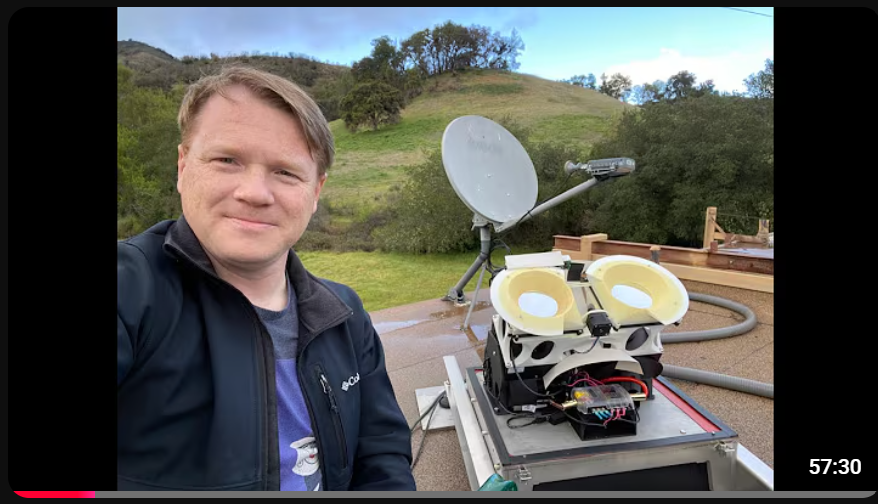
Each instrument contains:
- Two large scientific cameras
- Transmission gratings
- Commercial camera lenses
- An Intel NUC computer
- A Raspberry Pi control system
The Raspberry Pi functions as the central nervous system, handling coordination and control.
The cameras use very large sensors with exceptionally high quantum efficiency to maximize sensitivity.
Nearly all mechanical structures are custom-designed and 3D printed in polycarbonate.
The enclosure itself is medical-grade stainless steel to survive years of outdoor exposure.
Global Coverage
Once you have an instrument, the next challenge is deploying enough of them.
Unfortunately, whoever designed Earth included some very large oceans.
To cover the entire sky, we need instruments distributed globally, often near coastlines where they can observe regions over open ocean.
A complete system would require roughly a dozen sites worldwide, each containing four or five instruments.
The fifth instrument primarily helps cover polar regions.
Why Pair Sites?
Each region of sky is observed simultaneously from two widely separated locations.
This provides several advantages.
First, instead of two cameras observing an event, we now have four.
Second, our clocks are sufficiently accurate to measure propagation delays across the baseline.
That allows us to confirm that a signal originated beyond the local environment.
Third, weather is never perfect. If one site is cloudy, the paired site may still be operational.
Other Science
Laser SETI is useful for more than SETI.
Any phenomenon that produces bright, fast optical transients is potentially interesting.
NASA supplied us with one of their meteor cameras so that we could cross-calibrate observations.
The combination of wide field of view, high temporal resolution, and spectroscopy makes Laser SETI potentially useful for many transient astronomy applications.
By the Numbers
A single instrument requires approximately twenty-seven days of continuous 3D printing.
Each camera covers a 75-degree field of view—roughly equivalent to nine thousand full Moons on the sky.
The system can spatially resolve sources out to approximately twenty-five times the Earth-Moon distance.
Detection thresholds are on the order of a few hundred photons.
Each instrument processes over one hundred megabits per second of continuous data.
To date, Laser SETI has accumulated:
- Approximately 2,600 hours of observations
- More than 100 terabytes of data
- Over 8 million files
- Roughly 18 billion candidate events
We have observed three double-C4 events—the signature of a potential SETI detection.
Unfortunately, all three were eventually traced to a newly discovered camera anomaly in which detector rows occasionally reverse direction, creating a false signal.
We’re working with the camera manufacturer to understand the issue.
Current Status
The first instruments were installed at Robert Ferguson Observatory in 2019.
Pandemic-related delays postponed deployment of the next instruments at Haleakalā by approximately a year.
Today we have funding for additional observatories and expect to expand coverage substantially.
Ultimately we will need approximately ten more instruments to achieve full-sky coverage.
Closing Thoughts
Fast Radio Bursts were only discovered within the last decade, despite radio astronomy existing for more than seventy-five years.
They occur thousands of times per day across the sky, yet remained undiscovered because nobody was looking in the right way.
That gives me optimism.
Whether Laser SETI discovers evidence of extraterrestrial technology or entirely new natural phenomena, I believe it occupies a unique region of observational parameter space.
There is still a great deal left to discover.
Selected Audience Questions
Why is Breakthrough Starshot interesting from a SETI perspective?
Question: You mentioned beam shaping in the Breakthrough Starshot concept. How would that actually be implemented?
Eliot Gillum: The details are largely beyond my expertise, although the Starshot team has published papers and presentations discussing the concept. One advantage they have is an enormous phased array consisting of millions of lasers. The beam can be shaped both by how individual elements are aimed and by interferometric effects as the lasers are phased together.
What’s important from a SETI perspective is not necessarily the implementation details, but the fact that a propulsion beam must illuminate a region larger than the spacecraft itself. That creates spillover light that could potentially be detectable over interstellar distances.
The broader point is that beamed-energy propulsion requires fewer assumptions than intentional communication. A civilization may have no interest whatsoever in talking to us, but it may still build propulsion systems for exploration.
Question: Have you considered crowdsourcing the examination of candidate events?
Eliot Gillum: Yes and no.
Before involving large numbers of volunteers, there are several automated analyses I’d like to perform first. One particularly interesting approach would be clustering events by similarity and identifying recurring classes of phenomena.
The current classifier is highly specialized. It’s designed specifically to detect the types of signals Laser SETI was built to find. A logical next step would be developing broader classification tools that identify and organize everything else.
Crowdsourcing can be incredibly valuable. Tabetha Boyajian’s work is a great example of how citizen science can contribute to discovery. The challenge is determining what information should be presented to volunteers and how to do that effectively. Given the volume of data involved, that’s a substantial project in its own right.
How much data does Laser SETI produce?
Question: Is the observatory’s internet connection a limiting factor?
Eliot Gillum: Surprisingly, not at Robert Ferguson Observatory.
The instruments generate data continuously and at a fairly high rate. Each instrument writes to local storage, and we maintain a disk array at the observatory. Data is copied from the instruments to the array each night and then physically transported to our data center for ingestion and analysis.
At the time of this presentation, we had accumulated approximately 117 terabytes of data, representing essentially every pixel recorded since first light in August 2019.
Storage costs have fallen dramatically. Expanding storage is feasible, but as additional observatories come online, the volume of data will continue growing rapidly.
Do SETI scientists still use the Drake Equation?
Question: What is your current estimate from the Drake Equation?
Eliot Gillum: Speaking generally, SETI scientists don’t spend much time trying to calculate a precise answer.
Frank Drake originally developed the equation primarily as a framework for discussion during the first SETI meetings. It remains useful because it breaks the problem into understandable components.
We’ve learned a great deal about planets over the past few decades. We now know that planets are extremely common.
The difficult variables involve intelligence and technology.
We know biological life appeared on Earth. We know intelligence evolved multiple times. What we don’t know is how frequently technological civilizations emerge, or how long they survive.
In many ways, SETI is racing astrobiology.
I think it is becoming increasingly difficult to argue that biological life is rare. There are simply too many planets, too much chemistry, and too much time available.
Technological intelligence is a much harder question.
We’re conducting a real-time experiment with our own civilization, and we still don’t know how long a technological society can persist.
The good news is that astronomy is advancing rapidly. Exoplanet atmospheric studies, Mars exploration, ocean-world missions, and future observatories all have the potential to answer some of these questions.
I would not be surprised if we have dramatically stronger evidence regarding extraterrestrial biology within the next couple of decades.
Is There an Optical Equivalent to the Radio “Water Hole”?
Question: Radio SETI often focuses on the “water hole” region of the spectrum. Is there an analogous preferred wavelength for optical SETI?
Eliot Gillum: Not really. Several competing physical effects influence the answer. Shorter wavelengths can be focused more tightly, which improves transmission efficiency. Longer wavelengths experience less extinction from interstellar dust.
At distances of a few thousand light-years, visible wavelengths can still work quite well. At larger distances, infrared becomes increasingly attractive because more of the signal survives passage through the interstellar medium.
But the optimal wavelength depends heavily on the purpose of the signal.
If you’re trying to build an interstellar beacon, your answer may differ from someone building a propulsion system.
For something like a Starshot-style laser sail, shorter wavelengths become attractive because they focus more tightly and remain effective as relativistic Doppler effects shift the light toward longer wavelengths.
Ultimately there isn’t a universally preferred optical wavelength. The best choice depends on the goals and engineering constraints of the transmitting civilization.
Why Build an All-Sky System Instead of Targeting Specific Stars?
Question: Why did Laser SETI choose all-sky coverage rather than observing selected targets?
Eliot Gillum: Most previous optical SETI surveys focused on specific stars using relatively narrow fields of view.
That strategy works very well for persistent signals.
Laser SETI was designed around a different assumption: that the most interesting signals may be rare, transient, and unpredictable.
If a signal occurs only once—or only occasionally—then continuous monitoring becomes more important than extreme sensitivity on a small number of targets.
The philosophy behind Laser SETI is simple:
If something bright, narrowband, and unusual happens anywhere in the sky, we’d like to be watching when it occurs.