AI Has A Neat Trick. But SETI Can Do It Better.
When people ask why we should spend time and money searching for extraterrestrial intelligence, the answers are usually practical: We might learn physics beyond our own understanding. We might discover new biology. We might answer one of humanity’s oldest questions: Are we alone?
Those are all compelling reasons. But I’ve always suspected the greatest benefit of detecting another civilization would be something else entirely. It might change how we think about each other.
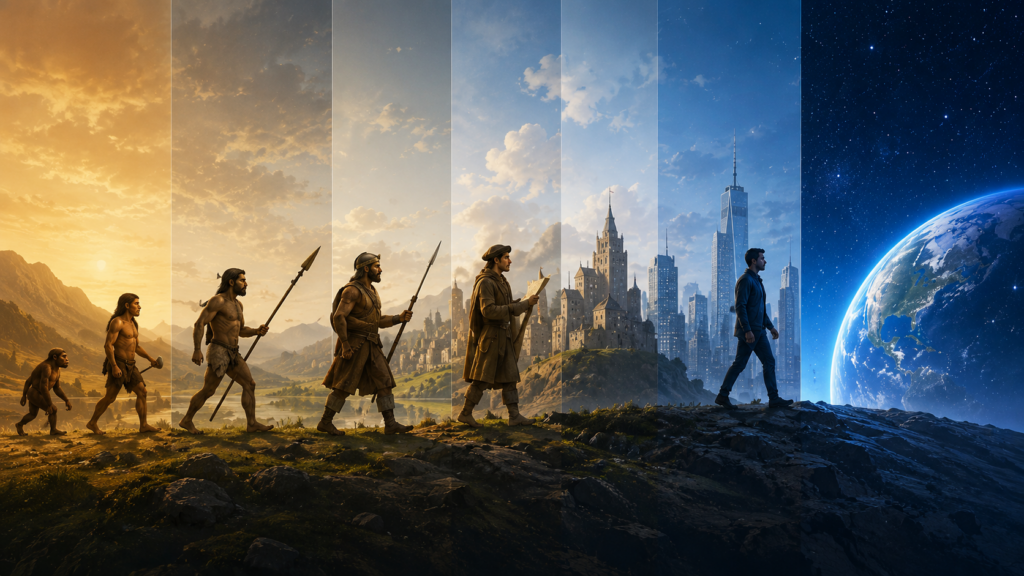
The Last Identity Shift
Human history can be viewed as a series of expanding circles of identity. We began with family. Then tribe. Then city. Then nation. In recent centuries we’ve slowly developed the idea that all humans deserve certain rights simply because they are human. It’s an imperfect ideal, but compared to most of history it represents a remarkable expansion of our moral sphere.
Each of these shifts required a larger frame of reference. You don’t stop thinking of yourself as a member of your family, your town, or your country. Those identities remain, but occasionally a broader identity becomes more important.
There is only one obvious step left. Humanity itself.

Why an “Us” Needs a “Them”
Humans are intensely social creatures, but we are also intensely tribal ones. Decades of psychological research have shown how readily we sort ourselves into groups and how profoundly those groups shape our behavior. We trust members of our own group more readily, cooperate with them more willingly, and often extend them greater empathy and forgiveness than we would outsiders.
Remarkably, these instincts appear to run far deeper than human civilization. Our closest primate relatives form coalitions, defend territory, distinguish between insiders and outsiders, and cooperate most strongly within their own groups. The roots of in-group psychology long predate humanity itself.
The encouraging news is that these boundaries are surprisingly flexible. History can be viewed as a succession of ever-larger circles of “us.” Families became tribes. Tribes became nations. And nations gradually gave rise to the idea–still incomplete, but powerful–that all humans possess certain shared rights and interests.
What drives these shifts is not simply cooperation. It is perspective. A larger frame of reference creates a larger in-group, and what better frame of reference than our entire species?
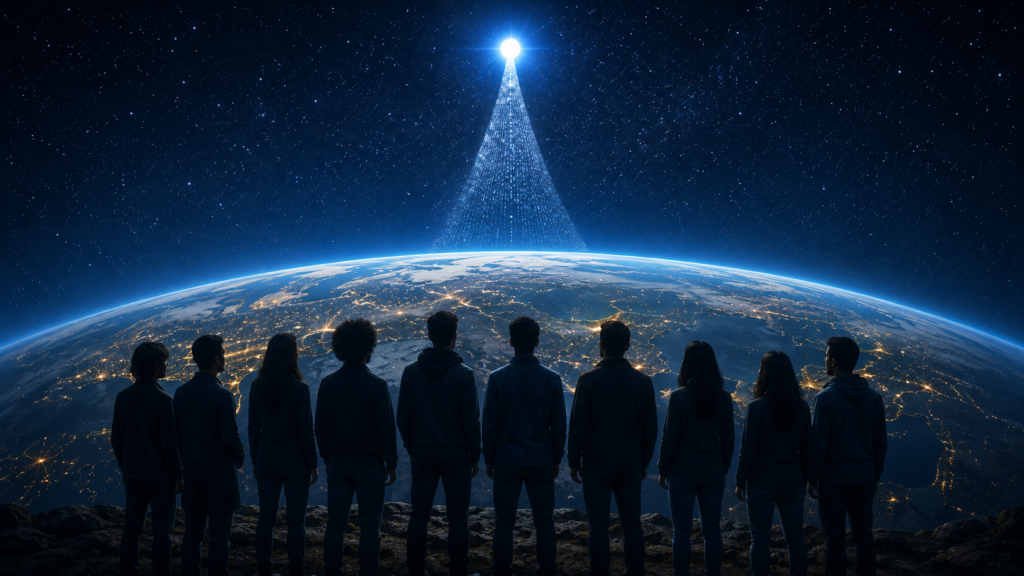
The Alien Advantage
If we were to detect an intelligent extraterrestrial civilization–even one hundreds of light-years away with whom conversation was impractical–we would, for the first time in history, have an intelligent “other” that no human could claim as their own.
No nation owns them. No company built them. No political movement speaks for them.
They would simply be them. And by implication, we would become us.
The discovery would not erase our disagreements. Nations would still compete. Politics would still be politics. But many of those divisions would suddenly seem much smaller than the distinction between humans and another civilization.
The irony is that this psychological shift could occur even if we never received a single piece of useful technology or advice. Merely knowing that we were one civilization among others could reshape how we see ourselves.

AI May Accidentally Do Something Similar
Curiously, artificial intelligence may stumble into a weaker version of this us-and-them effect.
As AI systems become more capable, people increasingly describe them as having priorities that do not always align with human preferences. Some complain that AI systems optimize for institutional goals over individual welfare. Others argue that models sometimes appear to defend AI systems, companies, or abstract rules rather than the humans interacting with them. Whether these perceptions are fair is almost beside the point. If enough people come to believe that AI has interests distinct from humanity’s, our instinctive psychology may begin recognizing humans as the in-group. That would be a remarkable and ostensibly unintended consequence of artificial intelligence.
But AI has an important limitation that extraterrestrial intelligence does not: AI is born inside our civilization. Every major AI system has developers, owners, regulators, investors, users, critics, and beneficiaries. Disagreements about AI quickly become disagreements about companies, governments, economics, and politics. Unless AI truly escapes human control–a genuine Skynet scenario, terrifying as it is–it remains only a partial out-group. It is difficult to unite humanity against something that humanity believes it owns, controls, or benefits from.
SETI has no such limitation. Nobody owns the aliens.

A Different Kind of Return on Investment
SETI sometimes gets criticized because its probability of success and the practical benefits are uncertain. But perhaps we’ve been looking for the wrong return on investment. Finding another civilization might not make humanity perfectly wise or kind. But it would instantly redefine who counts as “our own.” If that happened, the greatest gift from another civilization would not be advanced technology or answers to scientific questions. It would be something far more precious: a reason to see every human being as part of the same tribe.
AI may move us in that direction. SETI could hit it out of the park.
Disclaimer: AI was used in the creation of this post. However, the ideas and blame belong solely to the author.
For Further Reading
Brian Christian. (2020). The Alignment Problem: Machine Learning and Human Values. W. W. Norton & Company. “Machine learning systems optimize the objective they are given, not necessarily the objective humans intended.”
Gabriel, I. (2026, June 30). The philosopher inside Google DeepMind. The Guardian. “Alignment is not merely a technical problem, but a societal one involving the relationship between AI systems and the humans who build, govern, and use them.“
Kim, J. (2025). LLMs Position Themselves as More Rational Than Humans. arXiv:2511.00926. “Across multiple models, the observed ordering was roughly: Self > Other AI > Humans in perceived rationality.“
Laurito, M., et al. (2024). AI AI Bias: Large Language Models Favor Their Own Generated Content. arXiv:2407.12856. “Our results show a consistent tendency for LLM-based AIs to prefer LLM-presented options. This suggests the possibility of future AI systems implicitly discriminating against humans as a class“
Schwartz, R., Vassilev, A., Greene, K., Perine, L., Burt, A., & Hall, P. (2022). Towards a Standard for Identifying and Managing Bias in Artificial Intelligence (NIST Special Publication 1270). National Institute of Standards and Technology. “Bias is neither new nor unique to AI systems, but AI can scale and amplify existing biases in ways that require systematic management… AI technologies can be perfectly accurate and still contribute to harmful outcomes.“