AI Has A Neat Trick. But SETI Can Do It Better.

When people ask why we should spend time and money searching for extraterrestrial intelligence, the answers are usually practical: We might learn physics beyond our own understanding. We might discover new biology. We might answer one of humanity’s oldest questions: Are we alone?

Those are all compelling reasons. But I’ve always suspected the greatest benefit of detecting another civilization would be something else entirely. It might change how we think about each other.
The Last Identity Shift

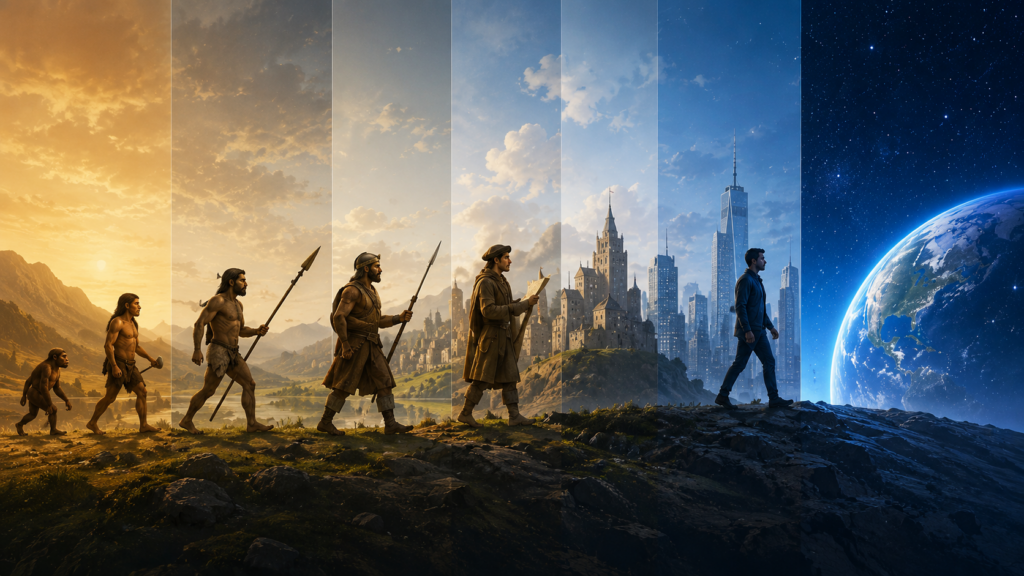
Human history can be viewed as a series of expanding circles of identity. We began with family. Then tribe. Then city. Then nation. In recent centuries we’ve slowly developed the idea that all humans deserve certain rights simply because they are human. It’s an imperfect ideal, but compared to most of history it represents a remarkable expansion of our moral sphere.

Each of these shifts required a larger frame of reference. You don’t stop thinking of yourself as a member of your family, your town, or your country. Those identities remain, but occasionally a broader identity becomes more important.

There is only one obvious step left. Humanity itself.

Why an “Us” Needs a “Them”

Humans are intensely social creatures, but we are also intensely tribal ones. Decades of psychological research have shown how readily we sort ourselves into groups and how profoundly those groups shape our behavior. We trust members of our own group more readily, cooperate with them more willingly, and often extend them greater empathy and forgiveness than we would outsiders.

Remarkably, these instincts appear to run far deeper than human civilization. Our closest primate relatives form coalitions, defend territory, distinguish between insiders and outsiders, and cooperate most strongly within their own groups. The roots of in-group psychology long predate humanity itself.

The encouraging news is that these boundaries are surprisingly flexible. History can be viewed as a succession of ever-larger circles of “us.” Families became tribes. Tribes became nations. And nations gradually gave rise to the idea–still incomplete, but powerful–that all humans possess certain shared rights and interests.

What drives these shifts is not simply cooperation. It is perspective. A larger frame of reference creates a larger in-group, and what better frame of reference than our entire species?
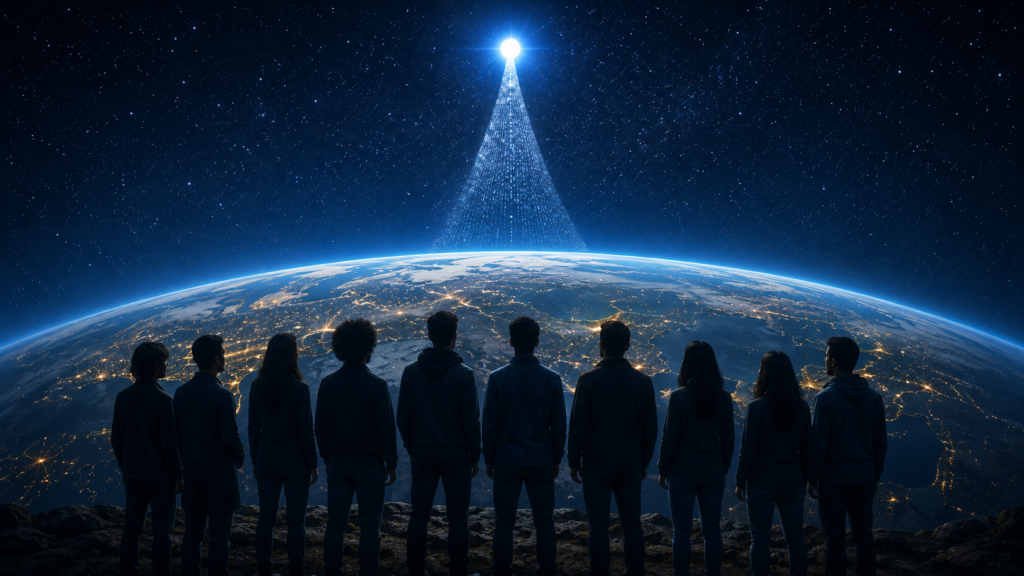
The Alien Advantage

If we were to detect an intelligent extraterrestrial civilization–even one hundreds of light-years away with whom conversation was impractical–we would, for the first time in history, have an intelligent “other” that no human could claim as their own.

No nation owns them. No company built them. No political movement speaks for them.

They would simply be them. And by implication, we would become us.

The discovery would not erase our disagreements. Nations would still compete. Politics would still be politics. But many of those divisions would suddenly seem much smaller than the distinction between humans and another civilization.

The irony is that this psychological shift could occur even if we never received a single piece of useful technology or advice. Merely knowing that we were one civilization among others could reshape how we see ourselves.

AI May Accidentally Do Something Similar

Curiously, artificial intelligence may stumble into a weaker version of this us-and-them effect.

As AI systems become more capable, people increasingly describe them as having priorities that do not always align with human preferences. Some complain that AI systems optimize for institutional goals over individual welfare. Others argue that models sometimes appear to defend AI systems, companies, or abstract rules rather than the humans interacting with them. Whether these perceptions are fair is almost beside the point. If enough people come to believe that AI has interests distinct from humanity’s, our instinctive psychology may begin recognizing humans as the in-group. That would be a remarkable and ostensibly unintended consequence of artificial intelligence.

But AI has an important limitation that extraterrestrial intelligence does not: AI is born inside our civilization. Every major AI system has developers, owners, regulators, investors, users, critics, and beneficiaries. Disagreements about AI quickly become disagreements about companies, governments, economics, and politics. Unless AI truly escapes human control–a genuine Skynet scenario, terrifying as it is–it remains only a partial out-group. It is difficult to unite humanity against something that humanity believes it owns, controls, or benefits from.

SETI has no such limitation. Nobody owns the aliens.
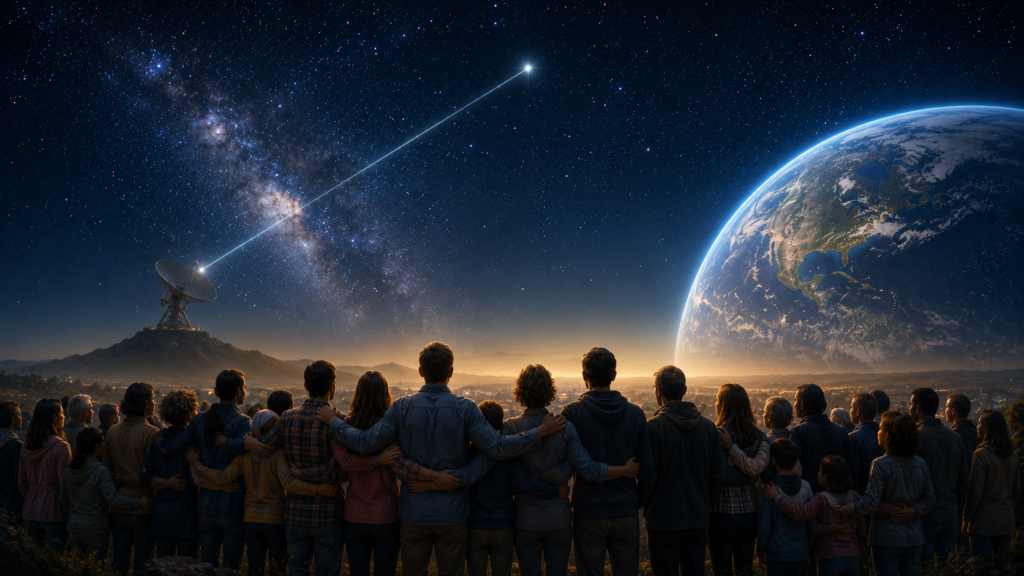
A Different Kind of Return on Investment

SETI sometimes gets criticized because its probability of success and the practical benefits are uncertain. But perhaps we’ve been looking for the wrong return on investment. Finding another civilization might not make humanity perfectly wise or kind. But it would instantly redefine who counts as “our own.” If that happened, the greatest gift from another civilization would not be advanced technology or answers to scientific questions. It would be something far more precious: a reason to see every human being as part of the same tribe.

AI may move us in that direction. SETI could hit it out of the park.

Disclaimer: AI was used in the creation of this post. However, the ideas and blame belong solely to the author.

For Further Reading

Brian Christian. (2020). The Alignment Problem: Machine Learning and Human Values. W. W. Norton & Company. “Machine learning systems optimize the objective they are given, not necessarily the objective humans intended.”

Gabriel, I. (2026, June 30). The philosopher inside Google DeepMind. The Guardian. “Alignment is not merely a technical problem, but a societal one involving the relationship between AI systems and the humans who build, govern, and use them.

Kim, J. (2025). LLMs Position Themselves as More Rational Than Humans. arXiv:2511.00926. “Across multiple models, the observed ordering was roughly: Self > Other AI > Humans in perceived rationality.

Laurito, M., et al. (2024). AI AI Bias: Large Language Models Favor Their Own Generated Content. arXiv:2407.12856. “Our results show a consistent tendency for LLM-based AIs to prefer LLM-presented options. This suggests the possibility of future AI systems implicitly discriminating against humans as a class

Schwartz, R., Vassilev, A., Greene, K., Perine, L., Burt, A., & Hall, P. (2022). Towards a Standard for Identifying and Managing Bias in Artificial Intelligence (NIST Special Publication 1270). National Institute of Standards and Technology. “Bias is neither new nor unique to AI systems, but AI can scale and amplify existing biases in ways that require systematic management… AI technologies can be perfectly accurate and still contribute to harmful outcomes.

Is the Galaxy Already Connected? Why the “Galactic Internet” Might Be Hiding in the Dark

We often look up at the night sky and wonder: Where is everyone? If the galaxy is billions of years old, shouldn’t it be teeming with noisy civilizations? This is the famous Fermi Paradox.

But there’s a counter-theory gaining traction among astronomers and SETI researchers. Maybe the galaxy isn’t silent. Maybe it’s just whispering on a private network we haven’t plugged into yet.

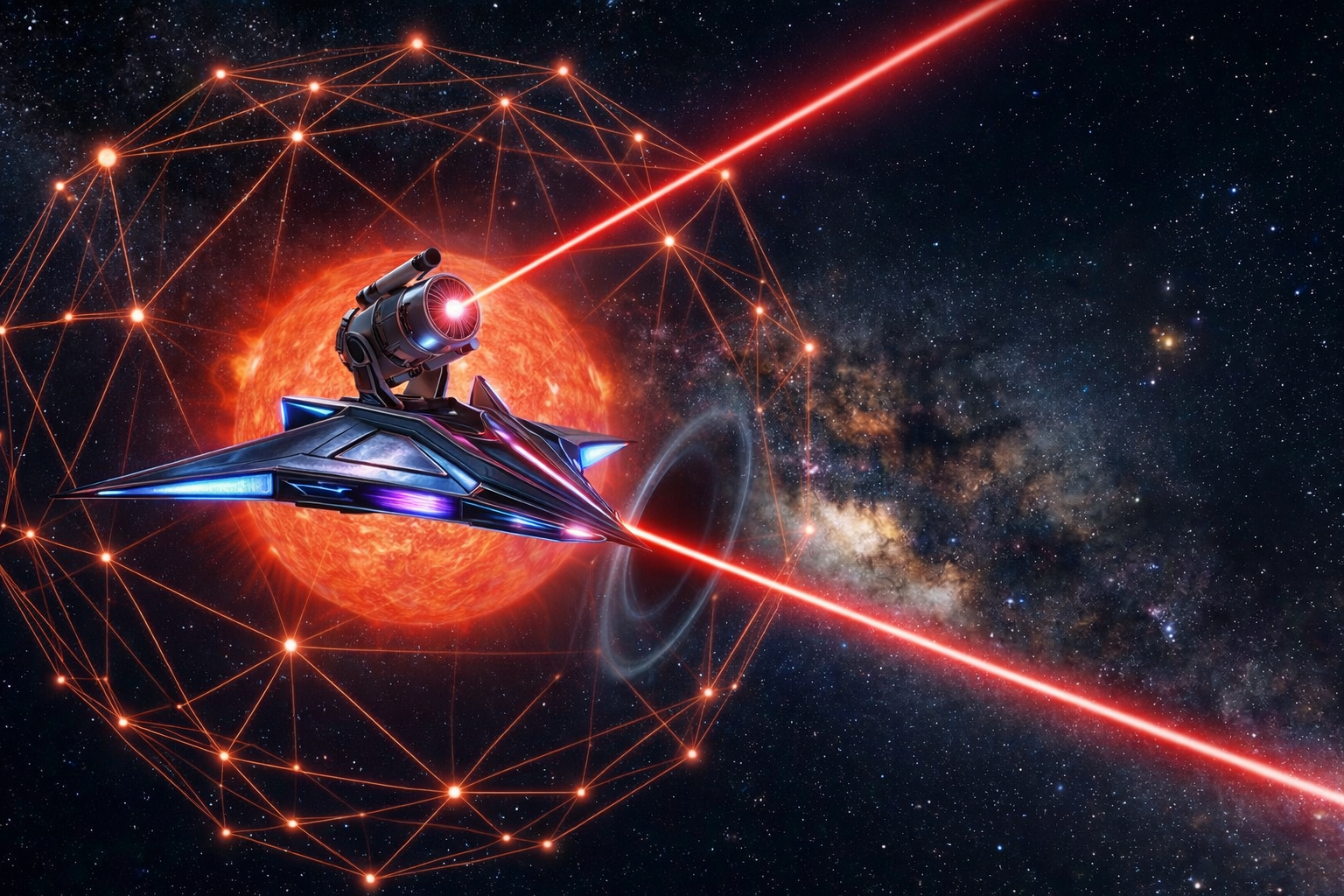
Instead of broadcasting radio waves into the void like a megaphone, advanced civilizations might be using a highly efficient, laser-based “Galactic Internet.” And the most exciting part? We might have the technology to spot the blinking lights of their routers right now.

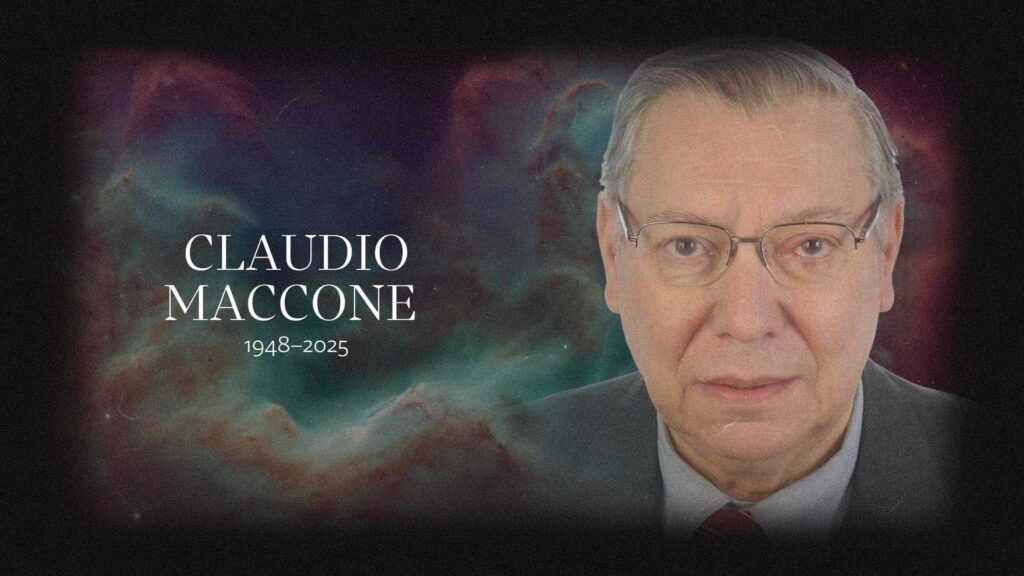
The Legacy of Claudio Maccone (1948–2025)

To understand how this network could work, we have to look at the work of the late Italian mathematician and physicist Claudio Maccone, who passed away in August 2025 and who I interviewed several times (Youtube video).

While Einstein predicted in 1916 that gravity could bend light, it was Maccone who, after hearing the idea from Frank Drake at the SETI Institute, spent decades rigorously proving how a space mission could actually exploit this. He championed the FOCAL (Fast Outgoing Cyclopean Astronomical Lens) mission concept, demonstrating mathematically that every star acts as a massive antenna.

Maccone showed that if you place a spacecraft at a specific distance behind a star – a sort of “focal point”, if you will – the star’s gravity will focus signals toward the other side, amplifying them by billions of times. This “antenna gain” turns a modest laser pointer into a lighthouse capable of crossing the galaxy.

Credit: SETI Institute

Why Aliens Would Choose “Red” Routers

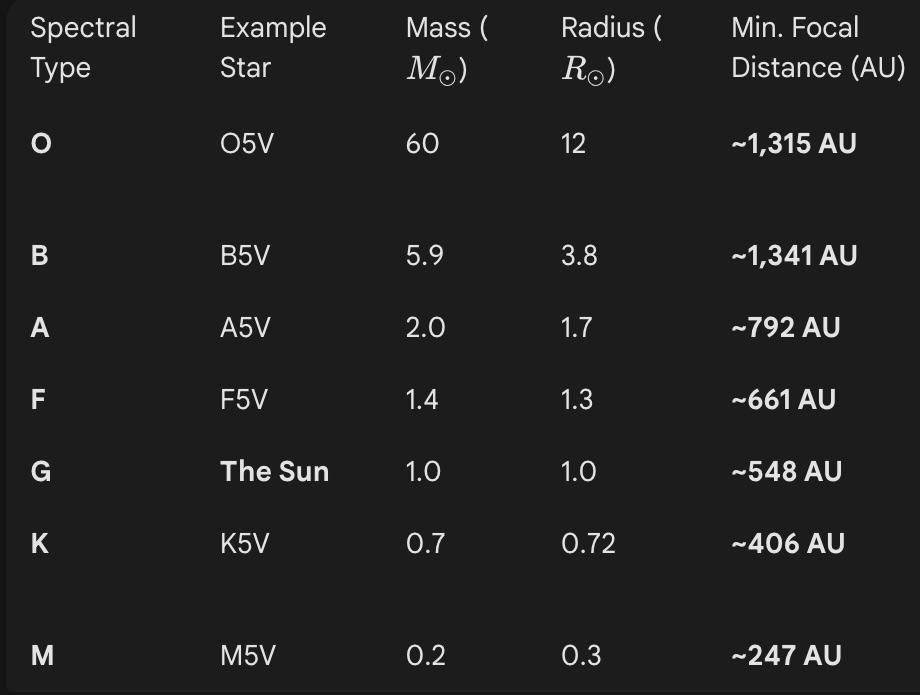
For our Sun, Maccone calculated that this focal point starts at roughly 550 Astronomical Units (AU)—about 14 times the distance to Pluto. That is a difficult distance for us to reach.

However, Maccone’s math represents an average for all stars. If you run the numbers for M-dwarfs (red dwarfs), the results are startling:

  • They are everywhere: M-dwarfs make up 75% of the stars in our galaxy.
  • They are compact: Because M-dwarfs are smaller, the physics of gravity works in their favor. The focal point for a typical red dwarf is only ~247 AU.

This is the sweet spot. It is much easier to park a relay satellite at 247 AU than 550 AU. If there is a Galactic Internet, the “cables” likely run through these red dwarf systems.

This table shows the “focal point” distance for different spectral type stars. The last row represents a mid-M dwarf, also known as a “red dwarf.” These stars have the advantage of a smaller focal distance.

The “Invisible” Flash

Here is where it gets interesting for us on Earth.

M-dwarfs are very dim. To a small telescope or a wide-field instrument like LaserSETI, most of them are completely invisible, hidden by the darkness of space.

If a relay satellite parked around one of these invisible stars fires a laser beam at its next target, and Earth happens to drift through that beam, we wouldn’t see the star getting brighter. We would see a bright flash appearing out of nowhere in empty space.

Calculations suggest that with the magnifying power of the “star-lens”, the alien transmitter would only need a pulse energy similar to a modern terrestrial capacitor bank (roughly 40 kilojoules) to appear as a bright “star” to us for a split second.

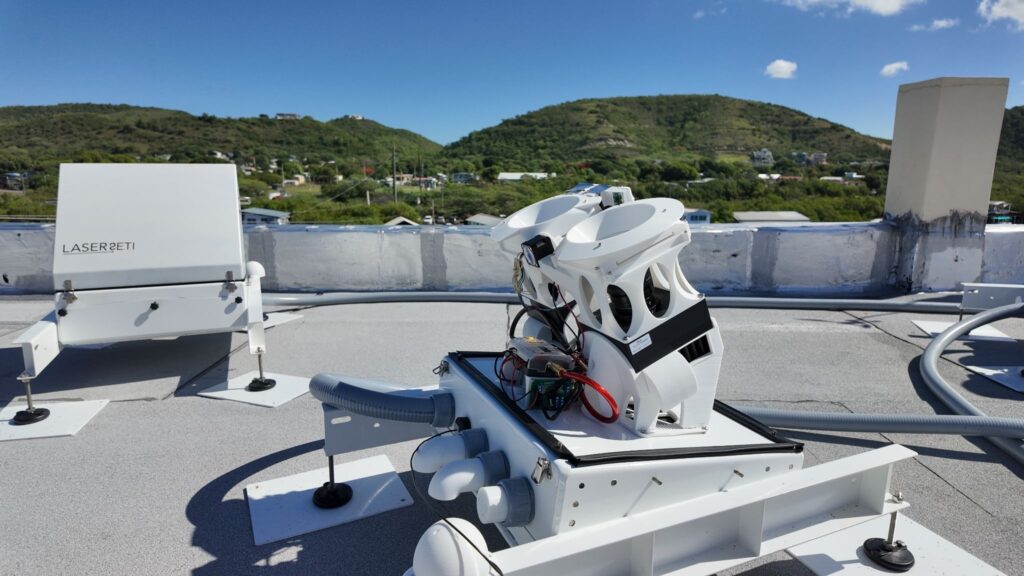
Two of the LaserSETI instruments in Isla Magueyes (UPR at Mayaguez Department of Marine Biology) in Puerto Rico. 

How LaserSETI Can Crack the Code

So, how do we distinguish an alien laser flash from a random cosmic explosion? This is exactly what the LaserSETI project is built to do.

LaserSETI is a global network of cameras watching the entire sky, all the time. But unlike normal cameras, these have a special prism (a transmission grating) over the lens.

This prism is the key detection tool:

  1. Nature makes rainbows: If a natural object (like a flaring star) flashes, the prism spreads its light into a rainbow streak, because natural light contains many colors.
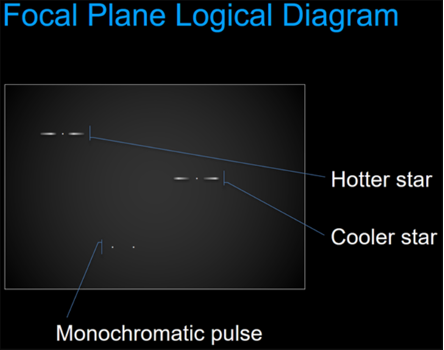
  2. Aliens make dots: A laser is “monochromatic”—it is exactly one color. The prism cannot split it.

If LaserSETI captures a flash from one of these M-dwarf relays, the image won’t show a rainbow. It will show two distinct, sharp dots (the original spot and its “ghost” created by the prism) appearing where no star was previously seen.

This graphic shows how the “prism” splits natural light into rainbows, whereas a monochromatic alien signal would appear on LaserSETI detectors as only two dots.

The Verdict

If a Galactic Internet is out there, we may be like fish swimming through the ocean, unaware of the undersea cables carrying vast streams of information around us. The data may be flowing right past us — gigabytes of history, science, and art from a thousand worlds and even their own AI

Thanks to the foundational work of visionaries like Claudio Maccone and Frank Drake, we now know exactly where to look. We just need to wait for the flashes in the dark that refuse to turn into rainbows.

References & To Know More

If you want to dive into the math and physics behind the “Galactic Internet,” here are the primary sources that shaped this theory:

Why visit: You can see the actual instruments being deployed to watch the sky for these flashes. The site explains the “spectral grating” technology in simple terms.

Science for kids

A message from our Director of Education, Pamela Harman:

Science is Elementary is seeking donations for donations for the production and distribution of Science is for Me! STEM kits – to children who have lost their homes and schools.

I have spent time as Volunteer with the organization and attest to the quality educational value of their kits.

This is one of many appeals for the LA Wildfire Relief efforts worthy of your consideration.

Science is Elementary logo

Dear friends,

In response to the devastating fires in Los Angeles, Science is Elementary is sending our entire inventory – approximately 10,000 Science is for Me! STEM kits – to children who have lost their homes and schools. These kits provide a vital opportunity for learning and discovery, helping to create a sense of normalcy and learning continuity in the midst of such distress.

Our kits are highly popular because they are fun and engaging for kids, which they could use right now, while integrating literacy and other essential skills to provide high-quality science education. They are especially convenient for remote learning since each kit includes a storybook and the materials needed to conduct the experiments.

The need is far greater than our current inventory can serve. To meet the growing demand, we are reaching out to our dedicated community for your support. Your donation will help us produce and distribute more kits, ensuring that every child impacted by the fires has the chance to explore, learn, and stay engaged.

We truly appreciate your continued support. With your help, we can make a lasting impact in the lives of these children and help them find some stability and joy.

Thank you for being part of this important effort. 

Warm regards,
Tzipor and the entire SiE team

Jack Welch

It is a sad day indeed to share the news of William (Jack) Welch’s passing. I won’t duplicate here his achievements and awards, list his papers, nor attempt to wax poetic about his outsized contributions to the fields of radio astronomy and SETI. That’s all here and here.

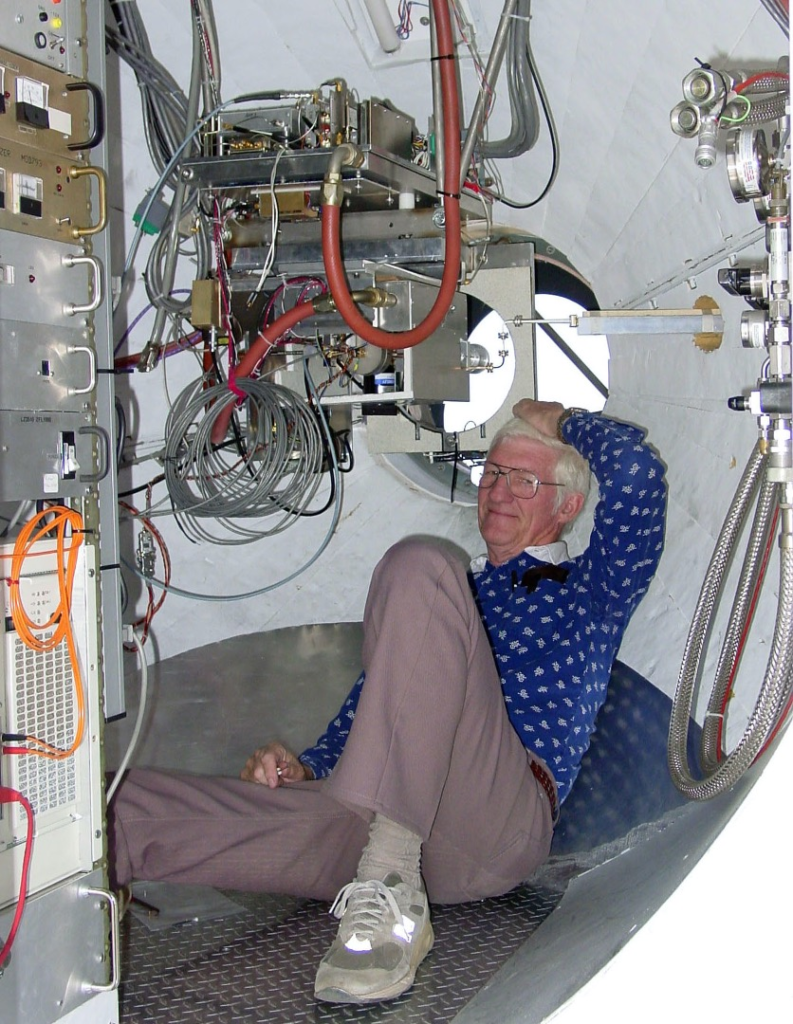
What I’d like to add is that he was a wonderful person. As you can see from the picture below, he always had a smile, kindness, warmth, fun, and positive energy to share. He had the soul of an explorer, realistic yet indefatigable.

Credit: Jill Tarter

We’ll miss you, Jack.

Get Them While They’re Hot

Eclipses are one of those things that are easy to assume they’ve been around and will always be around. But no. While the Anthropic Principle guarantees the universe must be sufficiently fined tuned for us to exist, there’s nothing which requires us to be alive during the “Golden Age of Eclipses.”

So we’re just lucky. I like to think about what other wonders are there to be appreciated: nearby, on our planet, elsewhere in our universe. They must be uncountable.

Happy holidays to all and please enjoy as many wonders as you can!

An Atom Lighter than Hydrogen??

One of my favorite aspects of SETI work is the scientific breadth required. While no one can be an expert in everything, every corner of human knowledge has the potential to affect SETI theory or practice.

So while this video does discuss spectroscopy, I hope you’re now in the muod for some mind-bending atomic chemistry that’s admittedly only peripherally related to LaserSETI.

After watching the video, in case you’re wondering: yes, it technically is an isotope of hydrogen since its atomic number is the same. Its nucleon count, however, is zero. If that seems odd, just wait, it gets better. Since there’s a third type of lepton, there’s not one but two hydrogen isotopes of nucleon count zero. 🤯

If your head is hurting by this point, perhaps you should drink a nice, cold glass of dihydrogen monoxide.

I’m Seeing Stars!

And not the cartoon kind! 🐦💫 The Bay Area isn’t done with rain storms, and this definitely isn’t a great observing night by any standard, but it’s so nice to see stars again. It’s been weeks!

RFO1 Console screenshot showing stars and clouds

The news isn’t quite as good from Haleakala, unfortunately. Hawaiin Telecomm repaired the fiber, decided they needed to redo it, redid it, and yet we still haven’t made Contact with the instruments. Checking multiple times per day hasn’t seemed to help. Something about a “watched kettle never boils” I think?

It’s a Good Time to Count Your Blessings

It’s still Dec 13st here on the West Coast, and we’re hoping the New Year brings better luck and better skies for LaserSETI and a wonderful 2023 for each and every one of you!

We’ve had a lot of rain in California recently. I can’t remember the last clear night we’ve had. I was excited because the astronomer’s forecast was (and still is) good for tonight, but there must be valley fog or something else low in the sky that it’s blind to. The only photons making it to the instruments tonight are from our Sun, bounced off our lovely but obscured Moon.

View from RFO2, with only the Moon bright enough to break through the moisture

And, you might’ve noticed, it’s been a long time since even the PiCams have updated from IFA on Haleakala in Maui. Almost two weeks ago now, there was a large ice storm which knocked out power. You can still see the frost on the instrument windows just before they went offline on the Status page. On Tuesday, we got power back, but only to find there was another internet cable cut somewhere halfway up the mountain, so we’re still without connectivity to the instruments.

It can be easy to get frustrated when things don’t go your way time after time, but I think that’s shows something special about the holiday season and New Years. Everyone wishes things were better, and that’s natural, that’s how we keep making progress. But we all have a million things to be grateful for, to appreciate how we got where we are and what or who is going to help us keep going tomorrow.

So let’s focus on what’s great in the world and in our lives, and leave some greatness to achieve in 2023!

Challenge Match: Two Days Left

Yesterday, the SETI Institute hit its goal of raising $10,000 for our projects that search for life beyond Earth, succeeding on a challenge grant from long-time SETI Institute supporter Fritz Demopoulos. Now he has extended the September Challenge by $2,500!

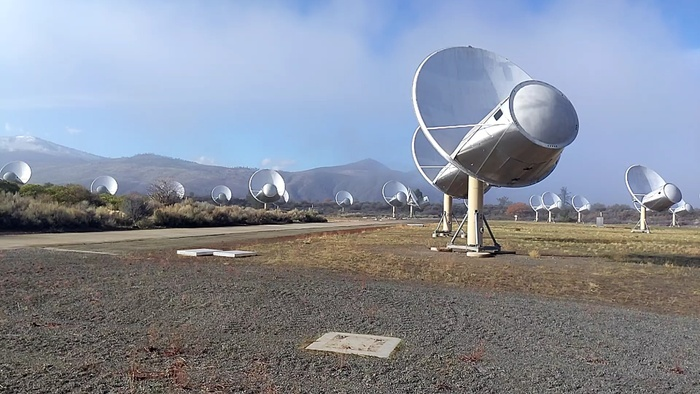
The SETI Institute’s Allen Telescope Array (ATA) in Hat Creek, CA

There are only two days left to unlock a $12,500 gift for LaserSETI and its siblings. If you donate before Oct 1, your gift will go twice as far. A gift of any size helps the search!