Is the Galaxy Already Connected? Why the “Galactic Internet” Might Be Hiding in the Dark
We often look up at the night sky and wonder: Where is everyone? If the galaxy is billions of years old, shouldn’t it be teeming with noisy civilizations? This is the famous Fermi Paradox.
But there’s a counter-theory gaining traction among astronomers and SETI researchers. Maybe the galaxy isn’t silent. Maybe it’s just whispering on a private network we haven’t plugged into yet.
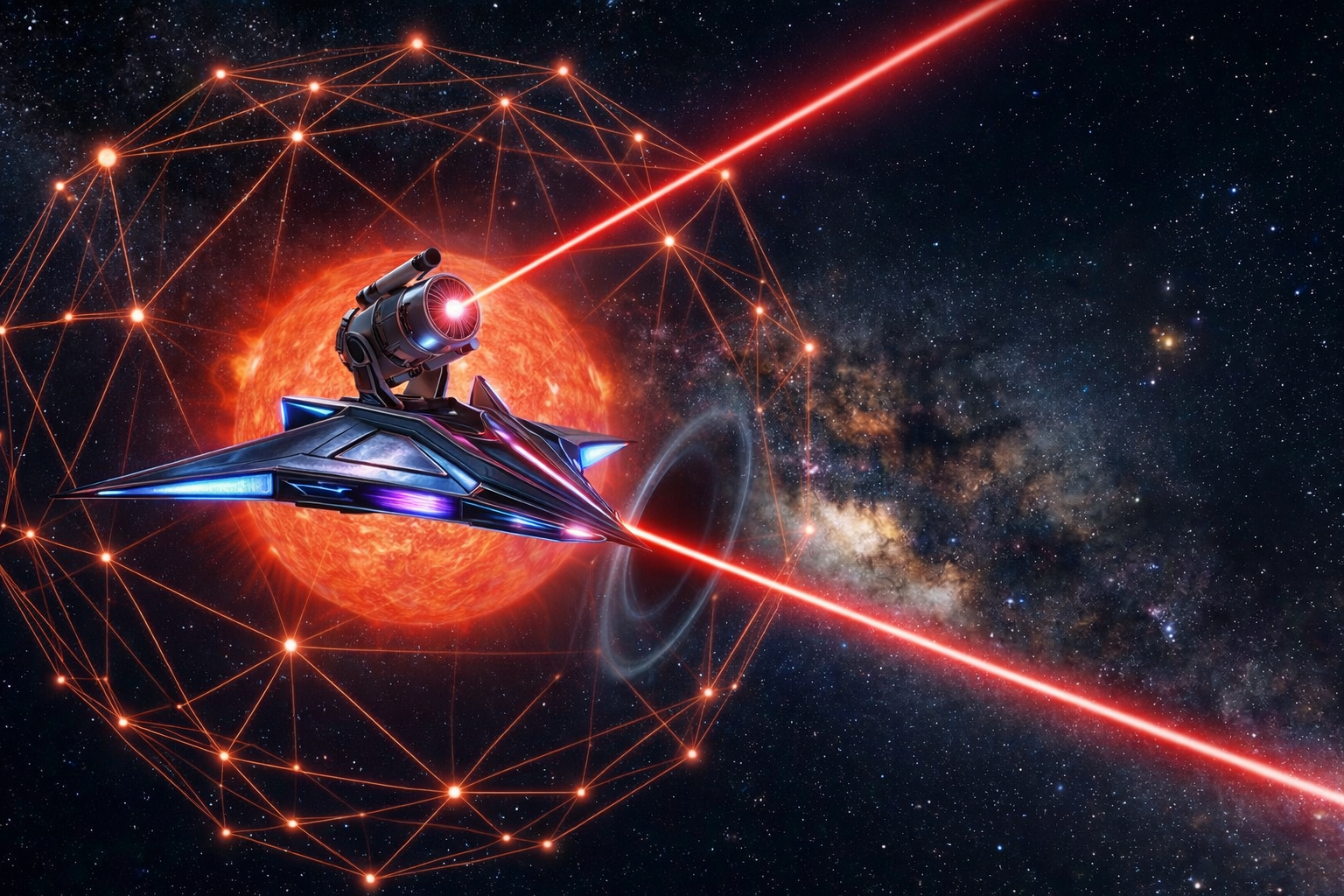
Instead of broadcasting radio waves into the void like a megaphone, advanced civilizations might be using a highly efficient, laser-based “Galactic Internet.” And the most exciting part? We might have the technology to spot the blinking lights of their routers right now.
The Legacy of Claudio Maccone (1948–2025)
To understand how this network could work, we have to look at the work of the late Italian mathematician and physicist Claudio Maccone, who passed away in August 2025 and who I interviewed several times (Youtube video).
While Einstein predicted in 1916 that gravity could bend light, it was Maccone who, after hearing the idea from Frank Drake at the SETI Institute, spent decades rigorously proving how a space mission could actually exploit this. He championed the FOCAL (Fast Outgoing Cyclopean Astronomical Lens) mission concept, demonstrating mathematically that every star acts as a massive antenna.
Maccone showed that if you place a spacecraft at a specific distance behind a star – a sort of “focal point”, if you will – the star’s gravity will focus signals toward the other side, amplifying them by billions of times. This “antenna gain” turns a modest laser pointer into a lighthouse capable of crossing the galaxy.

Credit: SETI Institute
Why Aliens Would Choose “Red” Routers
For our Sun, Maccone calculated that this focal point starts at roughly 550 Astronomical Units (AU)—about 14 times the distance to Pluto. That is a difficult distance for us to reach.
However, Maccone’s math represents an average for all stars. If you run the numbers for M-dwarfs (red dwarfs), the results are startling:
- They are everywhere: M-dwarfs make up 75% of the stars in our galaxy.
- They are compact: Because M-dwarfs are smaller, the physics of gravity works in their favor. The focal point for a typical red dwarf is only ~247 AU.
This is the sweet spot. It is much easier to park a relay satellite at 247 AU than 550 AU. If there is a Galactic Internet, the “cables” likely run through these red dwarf systems.
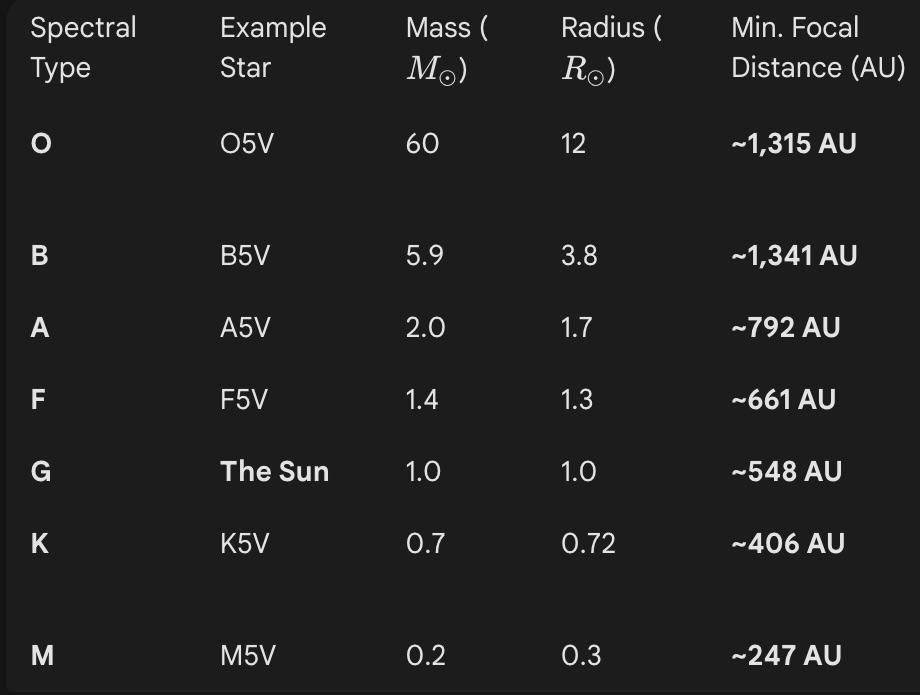
This table shows the “focal point” distance for different spectral type stars. The last row represents a mid-M dwarf, also known as a “red dwarf.” These stars have the advantage of a smaller focal distance.
The “Invisible” Flash
Here is where it gets interesting for us on Earth.
M-dwarfs are very dim. To a small telescope or a wide-field instrument like LaserSETI, most of them are completely invisible, hidden by the darkness of space.
If a relay satellite parked around one of these invisible stars fires a laser beam at its next target, and Earth happens to drift through that beam, we wouldn’t see the star getting brighter. We would see a bright flash appearing out of nowhere in empty space.
Calculations suggest that with the magnifying power of the “star-lens”, the alien transmitter would only need a pulse energy similar to a modern terrestrial capacitor bank (roughly 40 kilojoules) to appear as a bright “star” to us for a split second.

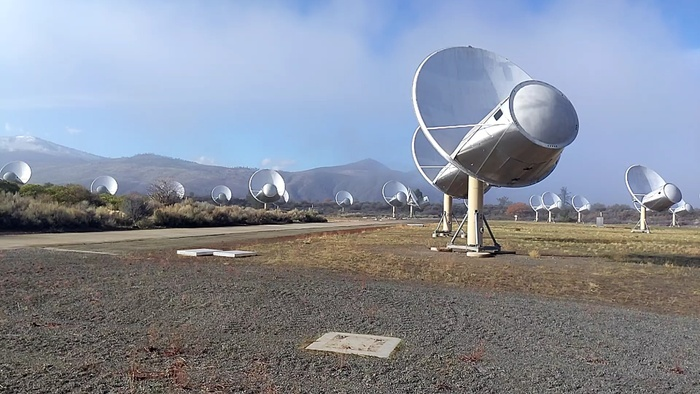
Two of the LaserSETI instruments in Isla Magueyes (UPR at Mayaguez Department of Marine Biology) in Puerto Rico.
How LaserSETI Can Crack the Code
So, how do we distinguish an alien laser flash from a random cosmic explosion? This is exactly what the LaserSETI project is built to do.
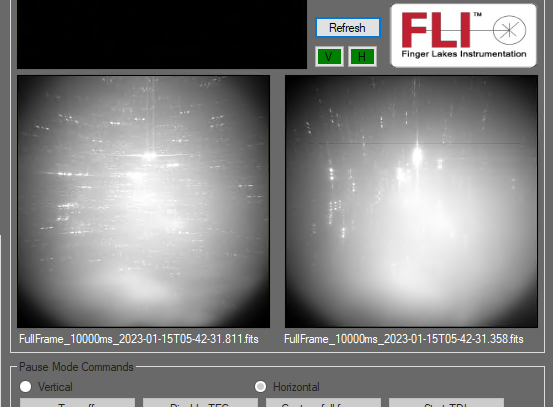
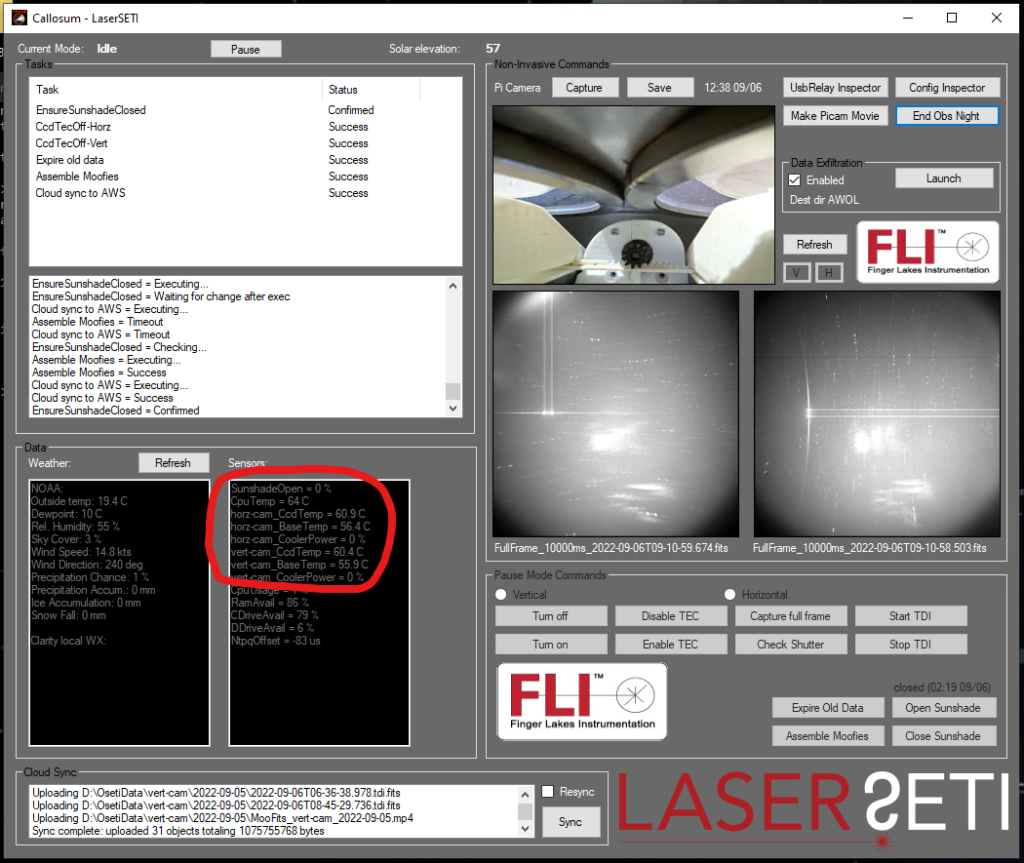
LaserSETI is a global network of cameras watching the entire sky, all the time. But unlike normal cameras, these have a special prism (a transmission grating) over the lens.
This prism is the key detection tool:
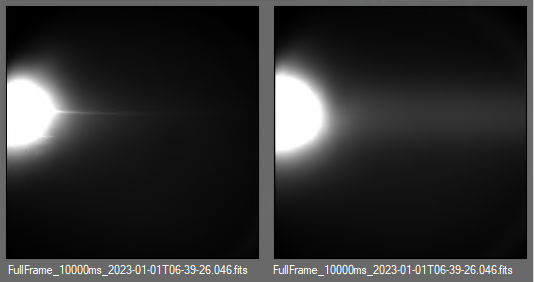
- Nature makes rainbows: If a natural object (like a flaring star) flashes, the prism spreads its light into a rainbow streak, because natural light contains many colors.
- Aliens make dots: A laser is “monochromatic”—it is exactly one color. The prism cannot split it.
If LaserSETI captures a flash from one of these M-dwarf relays, the image won’t show a rainbow. It will show two distinct, sharp dots (the original spot and its “ghost” created by the prism) appearing where no star was previously seen.
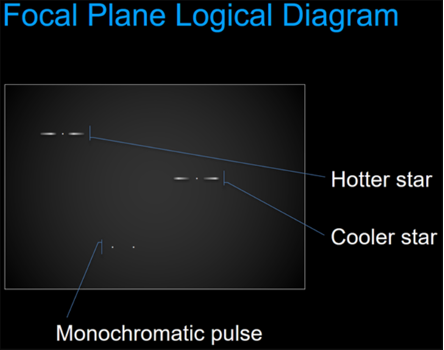
This graphic shows how the “prism” splits natural light into rainbows, whereas a monochromatic alien signal would appear on LaserSETI detectors as only two dots.
The Verdict
If a Galactic Internet is out there, we may be like fish swimming through the ocean, unaware of the undersea cables carrying vast streams of information around us. The data may be flowing right past us — gigabytes of history, science, and art from a thousand worlds and even their own AI.
Thanks to the foundational work of visionaries like Claudio Maccone and Frank Drake, we now know exactly where to look. We just need to wait for the flashes in the dark that refuse to turn into rainbows.
References & To Know More
If you want to dive into the math and physics behind the “Galactic Internet,” here are the primary sources that shaped this theory:
- The Blueprint:
- Maccone, C. (2009). Deep Space Flight and Communications: Exploiting the Sun as a Gravitational Lens.
- Why read it: This is the “bible” of the concept. Maccone provides the mathematical proof that the Sun (and other stars) can be used as massive antennas.
- The Network Architecture:
- Hippke, M. (2020). Interstellar Communication Network.
- Why read it: Hippke expands the idea from a single link to a full galactic web, analyzing why routing data through stars is more energy-efficient than direct beaming.
- The “Invisible” Target:
- Turyshev, S. G. et al. (2020). Direct Multipixel Imaging and Spectroscopy of an Exoplanet with a Solar Gravitational Lens Mission. (NASA/JPL)
- Why read it: While focused on us looking out, this paper confirms the “100 billion” amplification factor that makes the whole concept possible.
- The Detectors:
- The LaserSETI Project (https://laserseti.net/)
- Where to look: Visit SETI.org/LaserSETI.
Why visit: You can see the actual instruments being deployed to watch the sky for these flashes. The site explains the “spectral grating” technology in simple terms.